James Tauber's Blog 2006/10
Reddit Acquisition
Congratulations to the Reddit founders and employees and to Y Combinator on the acquisition!
by : Created on Oct. 31, 2006 : Last modified Oct. 31, 2006 : (permalink)
New Lens
My first Canon L-series lens arrived today. It's the EF 16-35mm f/2.8L USM.

The L-series in Canon lenses is like the M-series in BMW cars. The construction and performance are just at a totally different level than "lesser" models.
You can tell L-series lenses from a distance because they have the "red ring".
I haven't had a chance to try it out yet, but even the external look of it sets it apart: the casing is metal rather than plastic; there is no external change in lens length when focusing or zooming. And as the f/2.8 in the name suggests, there's no change to maximum aperture at different focal lengths.
I'm looking forward to having 16mm. Even though that's 25.6mm equivalent with my APS-C sensor, I can't wait for the extra field of view. And even though f/2.8 isn't quite as open as my 50mm f/1.4, it's by no means shabby and is hopefully worth spending the extra money over the 17-40mm f/4 L.
by : Created on Oct. 31, 2006 : Last modified Oct. 31, 2006 : (permalink)
TRS-80 CoCo and Bedlam
I'm reading Steve Wozniak's autobiography iWoz at the moment and so I've been reminiscing about my early Apple II days. Back in May 2001 when reminiscence last happened in a big way, I spent the weekend writing an Apple II emulator in Python (see ApplePy) :-)
This time, I also started reminiscing about the computer I had before the Apple II, the first generation TRS-80 Color Computer. My strongest memory of the CoCo was using the EDASM ROM cartridge to learn 6809 assembly language programming.
But I also remember playing text adventure games, like Bedlam.
With a bit of Googling, I found a CoCo emulator Java Applet that includes Bedlam. I don't think I ever got the game out as a kid. But last night I completed it in about an hour. Funny how back then it seemed like such a "big" game. In fact, it had only 25 rooms and 5 objects.
Still a lot of fun.
by : Created on Oct. 29, 2006 : Last modified Oct. 29, 2006 : (permalink)
Pyjamas Progress
Good progress has been made recently on pyjamas, the Python port of Google's GWT.
- I've moved the SVN repository to the new pyworks machine: http://svn.pyworks.org/svn/pyjamas/trunk/
- I've installed Trac 0.11dev and have it configured and up and running for pyjamas: http://trac.pyworks.org/pyjamas/
- Willie Gollino has implemented the Dynatable and JSON RPC examples
- Vicente J. Ruiz Jurado has implemented the Desktop App Clone example
A 0.1 release should come shortly now that all the examples have been implemented.
The goal of 0.2 will then be to iron out bugs in those examples and ensure they work on at least Firefox, Safari and IE.
by : Created on Oct. 28, 2006 : Last modified Oct. 28, 2006 : (permalink)
Reddit Feeds
Although it came out in May, I just discovered that reddit (whose main site I've used for a while) provides a web-based feed aggregator along the lines of a Bloglines or Google Reader but with the added feature of their voting system. Plus it integrates nicely with the main reddit functionality. Pretty cool stuff.
Check it out at http://feeds.reddit.com/
They offer import of subscriptions directly from Bloglines but it wasn't working for me when I tried it.
by : Created on Oct. 27, 2006 : Last modified Oct. 27, 2006 : (permalink)
Skipping Tracks
I've noticed for a while that I'm much more likely to skip over a good song on my iPod than I would if flicking through channels on the radio.
Thinking about it, I wondered if there's a certain loss of enjoyment in a song when you can hear it on demand.
But then on a trans-Atlantic flight on Monday, I noticed a similar phenomenon with playing my entire library versus just the playlist of my most highly rated. I'm far more tolerant of, say, a three-star song when listening to my entire library than a four-star song on my highly rated playlist.
So I've come up with the following formulation: The chance of skipping over a song is strongly positively correlated with the chance that the next song is at least as good.
With a "highly rated" playlist, there's a good chance the next song will be as least as good as the one I'm listening to, so I'm more inclined to skip the current song, even if I really like it.
With my entire library, if I'm listening to an "okay" song, there's a reasonable chance the next song will be one I like less, so I'm more inclined to enjoy the current song.
That's my current hypothesis, anyway. I haven't read George Zipf's work but I wonder if it relates to this.
by : Created on Oct. 25, 2006 : Last modified Oct. 25, 2006 : (permalink)
Coordinate Systems
Long overdue post to the Poincaré Project.
When we defined manifolds back in Poincare Project: Manifolds, we pretty much defined what a coordinate system is:
Define a chart to be a continuous one-to-one mapping from an open set to R^n.A manifold is a topological space covered by one or more charts. In other words, every point (and some open set the point is in) is part of at least one chart.
A chart provides a coordinate system and the coordinates of a point on a manifold are just the components of the point in R^n that the point on the manifold maps to in that chart.
So one way of thinking about coordinates is that they are tuples of real numbers that identify points on a manifold.
But it is important to note that coordinate systems are continuous. If you range one coordinate over a subset of its possible values, keeping any other coordinates constant, then you won't just get a random set of points, you'll get a continuous curve.
Note also that, although we often think about latitude and longitude as providing a coordinate system for the two-dimensional sphere, this single coordinate system breaks down at the poles. The north and south poles don't have a defined longitude. This doesn't pose a problem for either the latitude / longitude coordinate system or the manifold-ness of the sphere because (a) the latitude / longitude system works fine everywhere but the poles; (b) there is nothing wrong with a manifold requiring multiple overlapping coordinate systems to cover all its points.
To make this clearer, consider an even simpler example: the one-dimensional sphere, or circle. We could just map the points on the circle to [0, 1) but then we would get a discontinuity back at 0. So we have to use multiple overlapping coordinate systems:
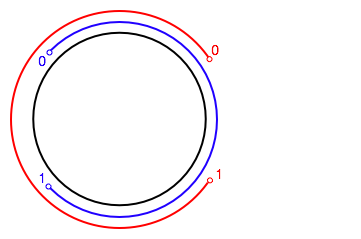
Here we have a red coordinate system which covers part of the (black) circle and a blue coordinate system which covers a different but overlapping part. For every point, there are coordinates for that point in at least one system and the system is continuous at that point. I've arbitrarily ranged the two coordinate systems from 0 to 1 but any continuous parameterisation of the coordinate curve would work.
Next we will reintroduce the notion of a metric defined in terms of coordinate systems.
UPDATE: next post
by : Created on Oct. 22, 2006 : Last modified Aug. 9, 2007 : (permalink)
Users Can't Change OS X Password Using passwd
I've previous mentioned I've got a new machine for pyworks.org.
Besides the problem that Trac doesn't work on Python 2.5, the other problem is the users I've created accounts for can't change their passwords.
I created the accounts with niload, just like I did on the older machine. But when people try to login and change their password, 'passwd' asks them for the old and new passwords and then just exits with 'Sorry'.
I can't see anything obvious in netinfo and no amount of Googling so far has turned anything up.
Any ideas under what circumstances passwd will refuse to change a user's password?
NOTE: It's not a problem with the password itself. If I log in as myself, I can change my password but if I log in as other user and try to change their password to the same one I used for my own account, passwd exits with 'Sorry'.
by : Created on Oct. 20, 2006 : Last modified Oct. 20, 2006 : (permalink)
Out of Commission
I'm somewhat out of commission at the moment.
I'm spending some time in London in a new apartment and it's going to take over two weeks for BT to install a phone line (and only then can I get ADSL broadband).
So at the moment my principal source of Internet connectivity is the nearest Starbucks with WiFi which isn't conducive to most of my online projects.
Sorry about that.
by : Created on Oct. 14, 2006 : Last modified Oct. 14, 2006 : (permalink)