James Tauber's Blog 2006/11
They Can't Hear Us
Pete Lacey has a great post They Can't Hear You on the gap between the corner of the blogosphere I tend to hang around in and what goes on inside most large enterprises:
the typical corporate technologist hasn’t considered REST and decided against it, they haven’t even heard the term. Ditto RelaxNG, Django, Atom, and everything else that makes the Web work and makes working with the Web easy.
Those technologies are each close to my heart, and get talked about by people on my blogroll all the time. Yet, I can confirm, a lot of really smart people in the industry haven't even heard of them. Any of them.
Well worth a read.
by : Created on Nov. 30, 2006 : Last modified Nov. 30, 2006 : (permalink)
PyCon Submission Rejected
Just got the rejection notice for my PyCon submission on pyjamas. The non-positives all had a single criticism: pyjamas isn't mature enough.
I don't quite agree—pyjamas is actually quite far along. Probably didn't help that I conservatively called the last release 0.1 even though it was probably more of a 0.5 :-)
They had a lot more submissions than places, though, so it looks like it will be a great programme, with or without pyjamas.
UPDATE (2006-11-30): The above makes me sound more upset than I am. I know how hard it is to draw a cut line when there are many more submissions than places so I don't envy the job the committee had. I was actually quite pleased that (lack of) maturity was the only negative reason given. That's easy to fix :-) But I'm still wondering if the 0.1 designation counted against me.
by : Created on Nov. 29, 2006 : Last modified Nov. 30, 2006 : (permalink)
Rosetta Stone
On Sunday, I thought I'd try out the online version of the Rosetta Stone language learning software. It works out much cheaper than buying the CD-ROM.
It uses Macromedia Shockwave which, it turns out, is not available as a Universal Binary yet, only PPC.
So to run the Rosetta Stone language learning software, I have to use Apple's Rosetta.
Funny, I thought. But then to top it all off, HB suggested we go to the British Museum that afternoon. And guess what we saw...
by : Created on Nov. 29, 2006 : Last modified Nov. 29, 2006 : (permalink)
Incompatible SQLite in OS X and Python
I started my porting of Quisition to django last night.
For development, I'm using SQLite as my database, but it seems I've hit a problem with conflicting versions.
Mac OS X comes with SQLite 3.1.3. That's what's used running sqlite3 at the command-line or running django's dbshell.
However, I'm guessing that when my application is running normally, django is using the SQLite that comes with Python 2.5 (which looks like it could be 3.3.5 or something).
As a result, databases created by django cannot be viewed using sqlite3 at the command-line or running dbshell. There must be a file format incompatibility between SQLite 3.1.x and 3.3.x as I get the error message:
Error: unsupported file format
UPDATE: I downloaded SQLite 3.3.8 and built it (although only after working out I needed to do a gcc_select 4.0 first). The new sqlite3 works fine on the django-generated database.
by : Created on Nov. 25, 2006 : Last modified Nov. 25, 2006 : (permalink)
Non-ACIDic Qantas Upgrades
I just had a bit of fright. I went on Qantas's website to see if I'd been upgraded on either of my flights tomorrow only to discover my reservation for the first flight had been cancelled.
I rang Qantas (whose telephone customer service is always excellent) and they not only assured me I still had a reservation but that I had indeed received an upgrade.
The only theory the representative could offer is that I'd logged into the website at the "split second" (her words) the upgrade was going through and I'd caught it after the economy class reservation had been cancelled but before the business class reservation had gone through. A refresh of the web page confirmed I had indeed between upgraded.
"This sort of thing happens all the time with computers," the helpful representative offered. I guess it does if the system doesn't follow the I in ACID :-)
by : Created on Nov. 22, 2006 : Last modified Nov. 22, 2006 : (permalink)
Pitch Perception Test
As part of his research at Harvard Medical School, Jake Mandell has a nice online pitch perception test that you can do in about 5 minutes.
Jake says that "the test is purposefully made very hard, so excellent musicians rarely score above 80% correct."
I got 80.6% on my first try, but I think Jake is being kind in his quote above because that only places me in the 66th percentile.
UPDATE: Next day I did the test again and got 88.9% (92nd percentile). That's quite a big jump :-)
by : Created on Nov. 21, 2006 : Last modified Nov. 22, 2006 : (permalink)
Coordinate Systems and Metrics
In the previous Poincaré Project post about coordinate systems, I introduced two charts that covered the circle and introduced a coordinate system ranging from 0 to 1 on each of them.
At the time I said:
I've arbitrarily ranged the two coordinate systems from 0 to 1 but any continuous parameterisation of the coordinate curve would work.
Here are three examples of different coordinate systems on the blue chart:
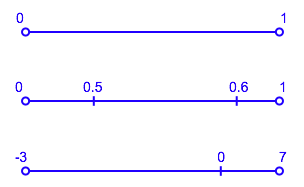
The point to show here is that not only is the choice of the end points arbitrary but that the coordinate can change at a different rate depending on where you are. In the second example, the distance between 0.5 and 0.6 is great than that between 0.4 and 0.5 or 0.5 and 0.6.
Notice that we haven't yet introduced any structure to the manifold itself that allows as to talk about distance without (as we've done on this web page) actually identifying the points in our manifold with points in a higher-dimensional euclidian space (in this case the R^2 of the screen).
This notion of the "rate of change" of the coordinate function lets us do so intrinsically, however. Say the distance between the point 0.5 and 0.6 is 5 in some units. Then the ratio of distance to change of coordinate is 5 / (0.6 - 0.5) = 50. Do this again from 0.5 to 0.55, or from 0.5 to 0.51 or from 0.5 to 0.5001. In other words, take the limit to a change in coordinate of 0.
This tells us how much distance is travelled as a proportion of coordinate change at the point 0.5. This "distance travelled as proportion of coordinate change" is called a metric for that coordinate system. Note that it's a function of the point you're at.
If you want to calculate the distance between arbitrary points with coordinates a and b, you take the integral of this metric function between a and b.
This new structure of a manifold with a metric defined on each chart is core not only to the proof of the Poincaré Conjecture but also to Einstein's General Theory of Relativity. In fact, by the time we've covered what we need for Poincaré, we will have covered more than enough mathematics to understand GR too.
One final thought: notice that, in our example, the metric isn't really telling you much about the manifold itself at all. The metric is merely expressing the relationship between the coordinate system and the notion of distance. We'll see shortly, however, that in dimensions higher that one, it goes beyond just telling you something about the coordinate system and allows you to describe the curvature intrinsic to the manifold.
UPDATE: next post
by : Created on Nov. 19, 2006 : Last modified Nov. 19, 2006 : (permalink)
Hans Rosling and Gapminder
I just watched one of the most informative videos I've ever seen: Hans Rosling's Talk at TED.
Not only is it a wonderful example of data visualisation, it is a fascinating, myth-busting look at what's really going on with world health and economic development.
Rosling calls his approach a "fact-based world view". He's also extremely entertaining.
The software behind his visualisations was developed by a non-profit he founded, Gapminder, and is free (as in beer).
Even if you don't check out the software - the video is well worth 20 minutes of your time.
by : Created on Nov. 18, 2006 : Last modified Nov. 18, 2006 : (permalink)
Why A-Sharp is Not B-Flat
I've talked before about note naming but because I was recently IMing with a friend about why A♯ != B♭ I've been thinking about a simpler way to explain it. It also explains why you can have double flats and double sharps (leading to 35 possible note names for 12 different pitches). Here goes...
- the vast majority of western music involves 12 notes in an octave
- the vast majority of western music is based around a scale consisting of 7 of those notes specific to the choice of key (the notes are called the diatonic notes for that key)
- a particular note in a piece is functioning either as a diatonic note or as a note a semitone higher or lower than a diatonic note
- when expressing a note that is functioning as a raised or lowered note, you use the same letter name as the diatonic note you are raising or lowering. e.g. a raised G is G♯ and a lowered G is G♭.
- if the diatonic note is already written with a sharp, the raised note has a double sharp and the lowered note has a natural symbol
- if the diatonic note is already written with a flat, the raised note has a natural and the lowered note has a double flat
- but in all cases, the letter part of the note name stays the same
So, imagine you're in the key of Gm. The diatonic notes are: G A B♭ C D E♭ F. What does A♯ mean? It means you've taken the second note of the scale and raised it. What does B♭ mean? It means the third note of the scale.
In 12-tone equal temperament, they may sound the same; you may play them the same on the piano or the guitar. But if the function of the note at a particular point in the piece is as the third note in the Gm scale, you can only write it B♭ and not A♯. A♯ means something completely different.
It's the musical equivalent of "hear" versus "here". Just because they are homophonic doesn't mean they are the same word. Similarly, in western tonal music B♭ doesn't mean the same as A♯.
by : Created on Nov. 17, 2006 : Last modified Nov. 17, 2006 : (permalink)
Milton Friedman
Milton Friedman has died at age 94.
While my sympathies are more with the Austrian School than the Chicago School, I found a lot in Friedman I agreed with and certainly a lot I respected. He probably did more than anyone else to educate the more general population about the benefits of free markets over Keynesian-style intervention.
That the use of the word 'liberal' is completely misused in the US is no more clear than in the obituaries I've read that talk about Friedman's opponents being 'liberals'. I can think of few people that better exemplified true liberalism than Friedman himself.
But although I learnt a lot about economics and economic policy from his writings, I think the thing I will always remember most about him is the loving relationship he seemed to have with his wife.
by : Created on Nov. 16, 2006 : Last modified Nov. 16, 2006 : (permalink)
Amazing Filter
When I got my EF 16mm-35mm f/2.8 L lens, I also bought a UV filter for it.
The box has an amazing without filter and with filter example:

Without the filter you couldn't even tell she's wearing a hat! Besides widening the field of view, the filter really brings out her smile. And visible signs of arm folding are dramatically reduced.
All this with one filter. Amazing!
by : Created on Nov. 16, 2006 : Last modified Nov. 16, 2006 : (permalink)
Quisition Going Django
I've decided I'm going to port my nascent flashcard site Quisition over to Django. I've started playing around with said web framework and, quite frankly, it's amazing.
Equally amazing is the ongoing Django Book and its comment system.
I've pretty much decided to throw away my home-grown web framework efforts and convert to Django. Hopefully I won't regret it :-)
(Needless to say, I plan to use pyjamas for the client-side parts of Quisition)
by : Created on Nov. 15, 2006 : Last modified Nov. 15, 2006 : (permalink)
System Preferences Accounts Empty
Today I went to System Preferences on Mac OS X and clicked on Accounts.
Nothing happened.
The title bar showed "Loading Accounts..." but never came back with anything.
Clicking on Accounts a second time and the window just went blank.
After rebooting and trying various things, I tried
nidump passwd /
in Terminal, which revealed the "problem". An 'oracle' user had been created (by the Oracle installer) without a realname.
So I did
sudo nicl . -create /users/oracle realname "Oracle"
and it fixed the problem.
Surely Apple could make System Preferences...Accounts a little more robust than this!
by : Created on Nov. 15, 2006 : Last modified Nov. 15, 2006 : (permalink)
Pyjamas 0.1 Released
I'm delighted to announce the release of pyjamas 0.1.
Pyjamas is a toolkit and library designed to enable writing AJAX applications in Python. It is based on Google's GWT which does the same thing for Java.
The pyjamas home page is at http://pyjamas.pyworks.org/
The goal for 0.1 was to get the GWT examples all mostly working on Firefox.
Thanks to Willie Gollino and Vicente J. Ruiz Jurado for making that possible.
by : Created on Nov. 6, 2006 : Last modified Nov. 6, 2006 : (permalink)
Scans of Complete Nibble Magazine Available
Nibble was my favourite Apple II magazine in the 1980s.
Recently, I found the official Nibble Magazine site. You can buy a DVD-ROM (or 10 CD-ROMs) with scans of the complete 12.5 years of the magazine.
Needless to say, I've put in my order :-)
by : Created on Nov. 4, 2006 : Last modified Nov. 4, 2006 : (permalink)
PyCon Submission on Pyjamas
I submitted a proposal to PyCon 2007 for a talk on Pyjamas. Playing on the name, I called the talk "Developing Web Applications in Pyjamas". I'll find out in two weeks if it got accepted.
(PS Just occurred to me that "Pycon" is the name of one of the twelve colonies in Battlestar Galactica)
by : Created on Nov. 1, 2006 : Last modified Nov. 1, 2006 : (permalink)